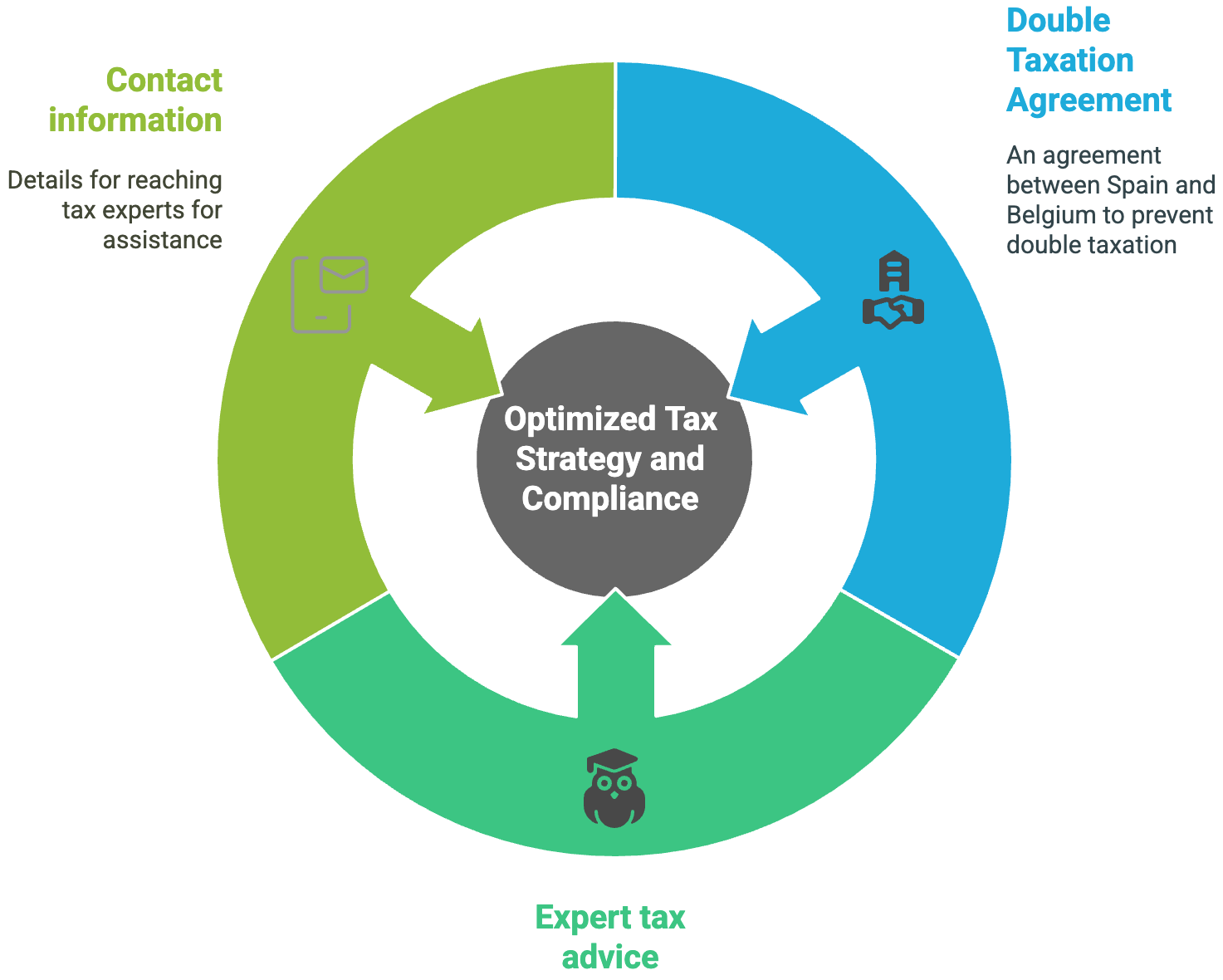
The Double taxation agreement (DTA) between Spain and Belgium is a treaty designed to prevent taxpayers from being taxed twice on the same income in both countries. In today’s globalized world, where individuals and businesses operate across multiple jurisdictions, this agreement provides legal certainty and optimizes taxation.
Belgium ranks as the eighth-largest destination for Spanish exports, with a trade volume exceeding €6.5 billion. In this article, we will explore the key aspects of the DTA and its application to both companies and individuals.
What is a double taxation agreement (DTA)?
A Double taxation agreement is a bilateral treaty signed between two countries to eliminate tax duplication when an individual or legal entity earns income in more than one state.
These conventions establish rules to determine where specific income should be taxed. Moreover, they are essential for fostering foreign investment, as they provide legal security to investors and reduce tax burdens.
Applicability of the DTA between Spain and Belgium
This treaty governs income and wealth taxes, setting out criteria for tax residency and procedures for resolving tax disputes. The main taxes affected include:
- In Spain: Personal Income Tax (IRPF), Corporate tax, and non-resident income tax (IRNR).
- In Belgium: Impôt des Personnes Physiques (IPP), Corporate tax, and other equivalent taxes.
Furthermore, the Protocol of April 15, 2014 introduced significant amendments regarding tax residency and the application of the agreement within Belgium’s political subdivisions.
Methods to avoid double taxation
The Spain-Belgium DTA provides two main methods to prevent double taxation:
- Exemption: One country may exempt certain income from taxation, allowing only the other country to tax it.
- Credit (Imputation): One country taxes income earned in the other state but allows the taxpayer to deduct taxes already paid in the other jurisdiction.
Tax residency criteria under the tax treaty
Article 4 of the DTA establishes the criteria for determining the tax residency of an individual or entity:
- Domicile, permanent home, habitual residence, or similar criteria
- Center of vital interests
- Nationality
- In case of conflict, resolution through mutual agreement between tax authorities
This aspect is crucial, as tax residency determines which country has the primary right to tax the taxpayer’s income.
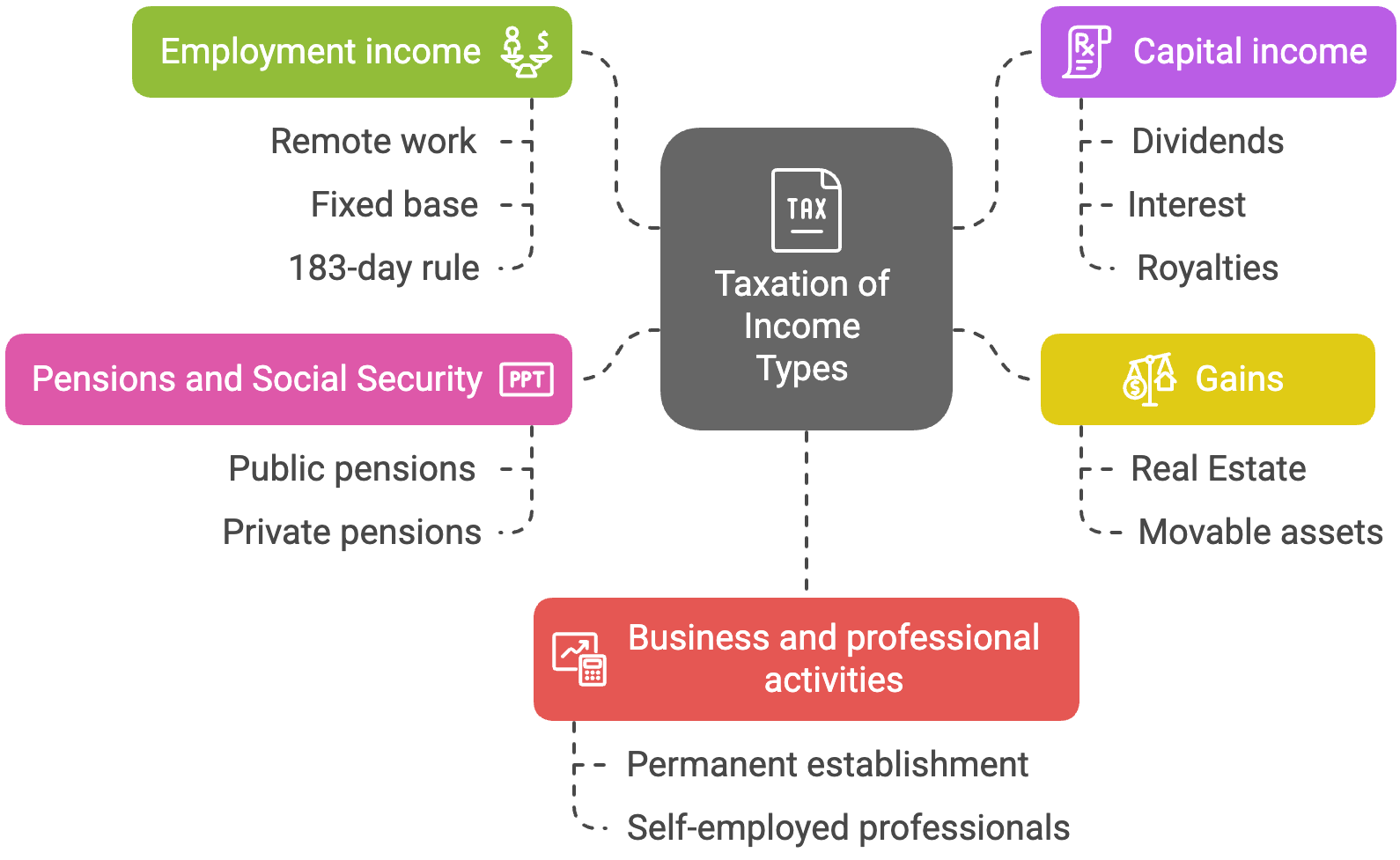
Taxation of specific types of income Spain – Belgium
The convention sets out specific rules for the taxation of various income sources:
- Taxation of employment income (article 1): Salaried employees are taxed in the country where the work is performed, except in certain cases, such as:
- Remote work
- The presence of a fixed base
- The application of the 183-day rule
- Taxation of capital income (articles 10, 11, and 12 of the DTA): Capital income, including interest, dividends, and royalties, is subject to specific treatment:
- Dividends: Taxable in the country of origin, with a maximum withholding tax of 15% if the beneficiary is a resident of the other contracting state.
- Interest: Typically taxable only in the resident’s country, except in certain cases where a reduced withholding tax applies at the source.
- Royalties: Follow a similar scheme to interest, although specific rules may vary depending on the nature of the income.
- Taxation of capital gains (article 13 of the DTA):
- Gains from the sale of real estate are taxed in the country where the property is located.
- For movable assets, taxation depends on factors such as holding period and asset location.
- Pensions and social security benefits (articles 18 and 19 of the DTA):
- Public pensions are taxed exclusively in the granting country.
- Private pensions may be subject to taxation in the beneficiary’s country of residence.
- Business and professional activities (articles 5 and 7 of the DTA): Business income is taxed in the country where the company has a permanent establishment. For self-employed professionals, taxation depends on where the economic activity is conducted and whether there are tax ties with the other country (article 7).
By understanding these principles, both individuals and companies can understand the Spain-Belgium tax framework efficiently while ensuring compliance with bilateral tax obligations.
Practical considerations for businesses and individuals
Companies operating in both countries should plan their tax strategy in advance, particularly regarding the existence of a permanent establishment, withholding taxes on dividends and interest, and the correct application of the posted workers’ regime. For businesses with subsidiaries in both Spain and Belgium, proper application of the treaty can significantly reduce tax costs.
For individuals, the correct determination of tax residency is important, as it defines where income is taxed. When it comes to employment income, it is essential to consider the possible application of tax exemptions if the job is performed in a country different from the country of residence. Moreover, pensions are subject to differentiated treatment, depending on whether they are public or private in origin.
Get specialized tax advice
The double taxation agreement Spain Belgium is a key tool for regulating the taxation of businesses and individuals with interests in both countries. Avoid unnecessary tax payments by seeking expert tax advice to ensure the correct application of the DTA and prevent double taxation.
Contact us for guidance on applying the agreement at info@arthurmarin.com or call us at +32 465 345 345. At Arthur & Marín, our team of international tax law experts can help you optimize your tax strategy and ensure full regulatory compliance.