

Carbon Border Adjustment Mechanism (CBAM) | A climate obligation for companies
The Carbon Border Adjustment Mechanism (CBAM) is reshaping international trade and introducing new legal and

Compliance is the the set of internal policies, practices, and controls that a business implements to guarantee legal compliance, lower risks, and conduct business in line with the standards pertinent to its operations is referred to as corporate and legal compliance. In addition to identifying, managing, and preventing the company’s legal or regulatory risks, compliance seeks to avoid fines.
Compliance is the system that aims to guarantee adherence to rules and standards, and it allows a business to:
Additionally, since it may eliminate or even lessen the criminal liability of legal entities (companies), compliance is very important. Because it affects the company’s liability as well as that of its directors and managers, compliance must be at the core of business activities and internal policies.

Our legal and corporate compliance services are designed for companies that need to implement or strengthen a compliance program capable of withstanding scrutiny from third parties, authorities, clients, and investors. It is particularly important for companies operating — or expanding — within the European Union internal market, whether small, medium-sized, or large, as well as for organizations exposed to public markets and institutions, regardless of their sector, size, or business model.
Starting activities or opening a subsidiary
Ensuring international regulatory compliance across countries and avoiding local regulatory discrepancies.
Receiving requirements from clients, suppliers, or authorities
Passing regulatory compliance assessments and meeting third-party requirements.
Public tenders or government contracting
Implementing policies and controls to meet contractual conditions and reduce risks.
Due diligence in investment, financing, or M&A
Organizing documentation, demonstrating diligence, and reducing risks.
Management of third parties (suppliers, distributors, agents)
Third-party due diligence, contractual clauses, and monitoring to mitigate risks across the value chain.
Incidents (requests, sanctions, claims, disputes, investigations)
Demonstrating response capability and reducing legal, regulatory, and reputational impact.
Compliance function acts as the overseer of international business activities by companies working in several countries.
Such activities entail different regulations, risks, and greater exposure.

In case an international company wants to operate through a local entity, it will inevitably need to adhere to local law as well as any foreign regulations applicable to the local entity. At the same time, there is a need to understand how to coordinate and harmonize local, e. g. European standards, laws, and sometimes extraterritorial regulations (e. g. US sanctions program) from the compliance perspective.
The establishment of a compliance system helps to achieve uniformity in decision, making among subsidiaries or branches and decreases mishaps or getting penalized due to the lack of regulatory knowledge in other countries.
The correct conduct of agents, distributors, business partners, and suppliers is crucial for a company to be considered as legally compliant and therefore be positive towards liability issues.
Compliance sets the standard for selecting companies to work with, establishing contractual terms, and continuous monitoring, especially in countries with higher legal exposure.
Compliance program implementation facilitates the delineation of duties and, especially in rapidly developing business environments and the varied nature of regions, countries, or local regulations, can be a source of comfort for executives and governing bodies.
Non, compliance with regulations, including local or sector, specific, and/or improper conduct may be the reason behind contractual issues and an international reputational crisis. Compliance with regulations, ethical obligations, and good industry practices minimizes all types of risks and enhances the organization’s capacity to respond effectively in the face of consequences.
Besides a law, binding requirement, the creation of a compliance program is a well of benefits. One of the advantages is that it can avoid the loss of the company’s assets. As it achieves this by the company being able to foresee situations that could result in compensation claims, fines, lawsuits, or even the suspension of business activities by judicial or administrative order.
Moreover, regulatory compliance is a significant contributor to the improvement of the company’s reputation. It is considered to be one of the most important factors for clients, investors, and partners, who want to be involved with companies that are ethical, transparent, and responsible. Consequently, the firm elevates its brand trust and market credibility.
Besides, compliance is one of the ways that allows companies to find out inefficiency and thus they end up reducing the cost of operation and increasing the competitiveness of the business. Therefore, regulatory compliance boosts the productivity and decision, making of the company.

Our legal compliance service is geared towards offering a compliance framework that fits the size, industry, and the regulatory maturity level of each organization. The package spans completely from the initial assessment to the continuous monitoring of your compliance enabling the processes, policies, and controls to comply with legal and regulatory requirements as well as with international standards of good governance. The significant elements of our service are:
Determining the applicable law, studying the case, evaluating the risks, and reviewing the controls. This evaluation helps to create an accurate, detailed implementation plan.
We dissect risks according to each enterprise, subsidiary, or corporate group divisions, by area, procedure, and regulation.
Regulatory compliance reports on issues such as data protection, competition law, business ethics, the prevention of corruption, relationships with authorities, and corporate conduct.
Constant tracking of legislative, regulatory, and technical changes that are relevant for the business, thus, allowing the speed of adaptation to the new technical or regulatory criteria and the positions of the authorities.
Support with certification processes, labels, and due diligence that ensures successful client and investor audits.
All sectors naturally have different legal requirements and requirements imposed by regulators. Our compliance service adjusts the framework applicable to both the industry and the sector, thus during the implementation we are in accordance with the standards expected by regulators, authorities, clients, and investors.

In anti, money laundering, financial fraud prevention, consumer protection, reporting, and financial control systems accordance of supervisory authority requirements.
Example: Setting up a compliance program for a digital payments fintech which resulted in a 40 percent reduction in regulatory reporting incidents.
Compliance for certifications, pharmacovigilance, data protection, pharmaceutical products and marketing, interactions with healthcare professionals, and bioethics frameworks.
Example: Helping a major laboratory with pharmaceutical regulations and professional interactions so that the company could successfully pass inspections.
Compliance with technical, environmental, safety, permits, and licensing requirements, as well as ESG compliance and sustainability reporting.
Example: Environmental and industrial safety compliance for an energy company with the result of fewer regulatory incidents by aligning internally to the regulations.
Matters relating to data protection, cybersecurity, intellectual property, platforms, and digital consumer rights.
Example: The preparation of data protection and cybersecurity policies line with international standards enabling a tech company to get certifications and grow its business.
The issues in this industry include supply chains, labeling and commercial practices, regulated advertising, consumer protection, and claims and incident management.
Example: Development and execution of consumer protection policies nationwide for a retail chain which not only enhanced the companys image in front of its customers and suppliers but also with the supervisory bodies.
Industries need to comply with overviews such as internal security, environmental standards, supplier control, technical certifications, labor compliance, and risk prevention.
Example: The company of manufacturing was helped through the process of standardization of regulatory control and permits which resulted in fewer non, conformities during inspections, thus, the company was able to improve its supply chain to a great extent.
The major areas are transportation, customs, foreign trade, cargo protection, international contracting, and environmental norms.
Example: An international logistics company applying foreign trade and customs compliance by the implementation of controls.
Public/private contracting, transparency, regulatory permits, labor compliance, and on, site safety.
Example: A labor and safety compliance report for a construction project that significantly improved the labor reputation with employees, contractors, and authorities.
Compliance requirements for telecommunications, rights of users, content protection, cybersecurity, and privacy.
Example: An analysis of a compliance framework in the areas of intellectual property and content rights for a digital media group.
European regulatory compliance has become a must for companies that want to operate in the European Union’s internal market. Because of the great number of rules that keep on changing in the EU regulatory environment, companies, organizations, and institutions have to decide which sector, specific regulations to apply to their activities.
The European Union is constantly making new regulations. That is why global businesses have to be very careful about the regulations so that they can quickly take the necessary actions to comply with the new requirements without prejudice to their commercial operation. This is exactly what enterprise compliance makes possible . Besides, European regulatory compliance helps a company to be transparent thus it will be easy for them to interact with national and European authorities as well as with international counterparts. It also raises companys chances of opening new markets, improving competitiveness, and gaining a good image among clients and suppliers abroad.
Moreover, it is a wise idea to factor in good governance standards, social responsibility, and respect for human rights. Those companies that embrace these values can set themselves apart from their competitors, especially in industries where openness and sustainability are critical.
Below are examples of the cases in the field of compliance in which our firm intervened.
It was the decision of a technology company, based abroad, to open their facilities in several European Union countries. The company reached out to us for being certain that they were following labor and data protection regulations of the EU. Through an analysis of regulatory requirements, the company was able to enter new markets, consolidate its operations at the main company, and unify the protocols of different countries.
A group of companies with several subsidiaries was not complying with local hospitality and catering regulations. Our intervention was aimed at each subsidiary being a hotel and hospitality sector compliance with the regulations of the country where they are located, a risk assessment of the different subsidiaries, and the alignment of corporate decisions with the local culture. Thanks to our services, the company was able to increase its productivity and its image.
An investment fund was willing to purchase an industrial company in France. Our work started with conducting a due diligence to detect possible non, compliance, uncovered risks, and liabilities of the target company. Our knowledge enabled us to find administrative breaches, discuss the economic terms of the contract, and get public aid. This facilitated the making of a more rational investment decision.
Regulatory compliance is not a solution that fits all types of companies and institutions. Different organizations have a different regulatory environment, with the first factor being the risks and the organizational structure, which depend on the size, sector, country, and activities. It starts from making a company’s risk profile clear, which involves a company understanding its industry, scale, processes, & level of exposure.
Once this evaluation is done, the company should be offered solutions and protocols that are in line with its needs and goals. Additionally, our legal advisory services will add value. We guide companies through their decision, making processes, internal investigations, regulatory audits, etc. Having qualified professionals who simultaneously keep the clients informed about the regulatory environment and provide legal advice, is a real competitive edge.
In brief, our distinguishing features are our capabilities to give clients personalized solutions, which are directed exactly to the nature of their specific business.
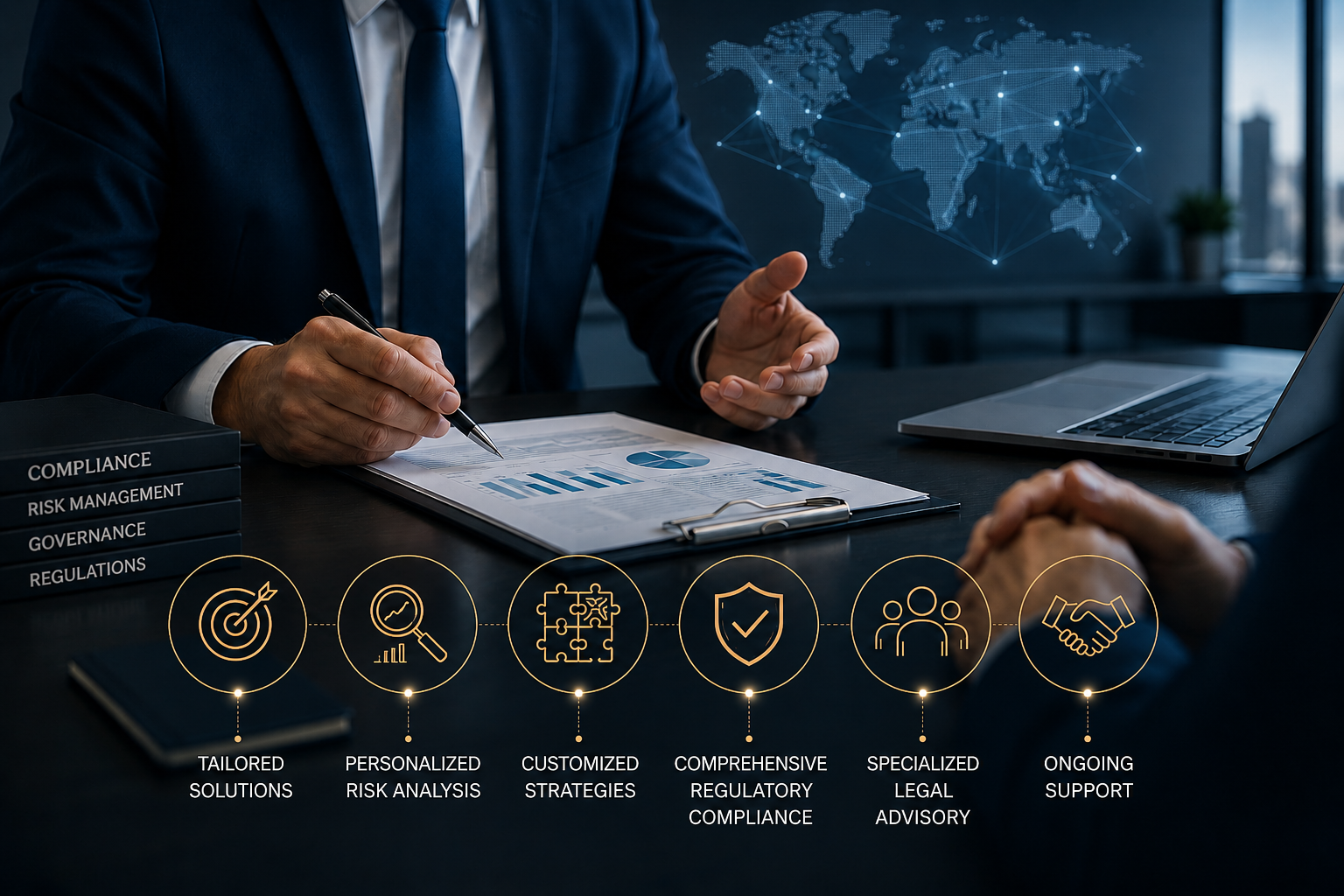
Compliance encompasses a company’s set of rules, policies, and best practices that enable it to act in accordance with the law and maintain ethical behavior.
Nowadays, corporations are required to demonstrate their ethical behavior. Compliance prevents the imposition of penalties and, more importantly, keeps the companys good name safe and well, informed by clients, authorities, and investors.
The firms that most need compliance support are the companies in regulated sectors, those that work with public administrations, those that handle personal data, or those that operate in numerous countries. Equally, it is a matter of principle for organizations that collaborate with suppliers in developing countries or that are involved in investment, financing, or similar processes.
Crimes of corporate criminal liability can be committed by any company, without distinction of their size. Besides liability, compliance is a way that companies can use to differentiate themselves from competitors. Take the case of an SME which works with institutions or participates in public tenders; for them, it is a lever to their advantage showing that they are law, abiding and ethically run companies.
A compliance program helps prevent and detect crimes, workplace accidents, regulatory or sector-specific non-compliance, breaches of national or EU law, data protection violations (GDPR), as well as fines and other sanctions.
Due diligence consists of investigating, among other things, who a company is hiring (suppliers, clients, or partners) or the company or product it intends to acquire. If a supplier commits a violation and no due diligence was conducted, the contracting company may be held responsible for the resulting harm.
It is unquestionably an investment. Compared to the cost of a fine or sanction, or even more seriously, the loss of customer trust—which can destroy a company’s value in a matter of days—compliance is highly cost-effective.
This is where international compliance becomes relevant. The company must adopt an international baseline standard or adapt each subsidiary or branch to the sector-specific regulations of the country where it operates. Within the EU Single Market, regulations are more harmonized, making it easier to comply with local laws in each Member State.
It depends on the size of the company, its sector, and whether it operates in one or multiple countries.
The Carbon Border Adjustment Mechanism (CBAM) is reshaping international trade and introducing new legal and

Regulation (EU) 2025/258 mandates changes for heavy and medium-duty vehicles (trucks and buses) to reduce

How to apply European regulations in national public administrations is an essential condition to ensure

Complying with European regulations is not optional. For any company operating within the European Union

Regulation (EU) 2025/40 from the European Parliament and the Council is set to replace the

In recent years, European authorities have imposed fines worth billions of euros on companies of

Advertising in regulated sectors is an activity that combines creativity with compliance with the legal
Contact Arthur & Marin for expert advice on legal compliance and European regulatory compliance. Our firm advises national and international companies on the implementation of compliance programs, regulatory risk management, internal audits, due diligence, and adaptation to European and international regulations.
We analyze each organization individually, evaluating its sector, structure, level of exposure, and international activity, with the goal of developing compliance solutions tailored to the regulatory, operational, and commercial requirements of each company.
info@arthurmarin.com
+32 465 34 53 45