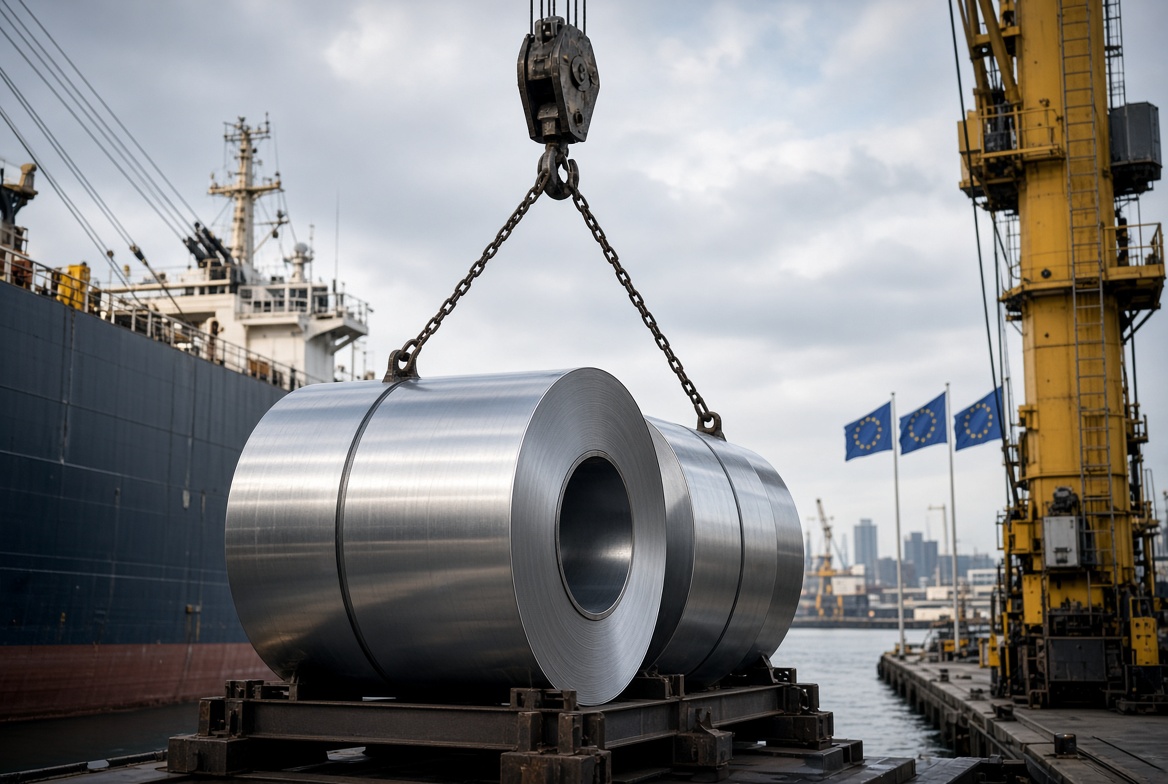
The Carbon Border Adjustment Mechanism (CBAM) is reshaping international trade and introducing new legal and financial obligations for companies. Importing certain products into the European Union now requires understanding how to calculate emissions, meet reporting deadlines, avoid penalties, and anticipate future costs. In this article, we explain CBAM in a practical and clear way, analyze how it really affects companies, the main obligations, risks and sanctions, and the steps businesses can take to protect their operations and prepare in advance.
What is CBAM and why does it affect trade?
CBAM (Carbon Border Adjustment Mechanism) is a new obligation introduced by the European Union to include the cost of CO₂ emissions in international trade. Its goal is to prevent companies from moving production to countries with less strict climate rules and to create a fair balance between products made in the EU and those imported from outside the EU.
Unlike other environmental regulations, CBAM does not only apply within the EU. It has a direct impact on international trade, affecting how companies buy, sell and set prices in cross-border transactions.
Legal framework of the Carbon Border Adjustment Mechanism (CBAM)
The Carbon Border Adjustment Mechanism (CBAM) is regulated by Regulation (EU) 2023/956, which applies directly in all EU Member States. As we will see, this is a binding legal obligation for companies that import certain products into the European Union (not just a recommendation). CBAM requires importers to declare the greenhouse gas emissions embedded in the products they bring into the EU and to purchase CBAM certificates to cover those emissions. In this way, the EU extends to international trade a principle already used in its climate policy under the European Green Deal: “the polluter pays.”
Difference between CBAM and customs tariffs
Although CBAM can increase the cost of importing goods, it should not be confused with a customs tariff. Tariffs are usually applied as a fixed rate based on the value of the product. CBAM, however, is calculated based on the CO₂ emissions linked to the production of that product. This means that two similar products imported from different countries may face different CBAM costs, depending on their carbon footprint and how carbon-intensive their production process is.
Which sectors and business operations are affected?
The Carbon Border Adjustment Mechanism (CBAM) does not only impact direct importers. It can also affect many other economic sectors indirectly, because costs and compliance requirements often spread along the supply chain. Below, we explain the main products and sectors affected, as set out in the Regulation.
Imports directly affected by CBAM
Companies that import into the European Union products with a high CO₂ footprint are the first ones required to comply with CBAM. The sectors most clearly affected include:
Steel and metal industry
Companies importing steel, iron, or semi-finished products (such as sheets, bars, pipes, and profiles) must declare the emissions embedded in each import. For example, an industrial company importing steel from Turkey or China for processing within the EU is fully subject to CBAM.
Aluminium industry
Manufacturers and distributors importing aluminium or certain aluminium-based products (such as ingots, sheets, and profiles) may see higher import costs depending on how carbon-intensive the foreign supplier’s production method is.
Fertiliser sector
Agri-businesses or distributors importing nitrogen-based fertilisers from non-EU countries must meet CBAM requirements, which can directly increase agricultural production costs.
Energy sector
Companies importing electricity from countries outside the EU—especially in border areas—must treat CBAM as a new regulatory and economic factor in their operations.
Emerging hydrogen industry
Companies importing hydrogen produced outside the EU are already included within CBAM. This creates early compliance pressure in a fast-growing sector.
Activities indirectly impacted by CBAM
Beyond direct importers, CBAM also has indirect effects on many sectors that rely on these products—even when those companies do not import themselves. This happens because suppliers often pass CBAM-related costs along the supply chain.
Construction and real estate development
Construction companies and developers may face higher prices for steel and cement used in projects, as suppliers transfer CBAM costs through the supply chain.
Manufacturing and industrial processing
Automotive companies, industrial machinery manufacturers, and producers of capital goods that use imported steel or aluminium may see rising costs and may need to renegotiate supply contracts.
Agri-food and chemical industry
More expensive imported fertilisers can directly increase agricultural production costs and, in turn, affect the final prices of food and related products.
Distribution and wholesale trade
Distributors who do not import directly but sell products made with CBAM-covered materials may be affected by price adjustments, supplier changes, or reduced margins.
Companies with global supply chains
Corporate groups sourcing from non-EU suppliers may need to review procurement strategies and prioritise manufacturers with a lower carbon footprint to reduce both regulatory and economic impact.
Summary table CBAM products and affected business sectors
| CBAM-covered product | Sectors directly affected | Sectors indirectly impacted |
|---|---|---|
| Iron and steel | Steel importers, steelmaking, metallurgy, industrial processors | Automotive, construction, industrial machinery, capital goods |
| Processed steel products (sheets, pipes, profiles) | Industrial manufacturers and distributors, processing companies | Energy, infrastructure, engineering, logistics |
| Aluminium | Importers of primary and semi-finished aluminium | Automotive, packaging, aerospace, construction |
| Cement | Importers of cement and cement-based products | Construction, public works, real estate development |
| Fertilisers | Importers and distributors of nitrogen fertilisers | Agriculture, agri-food, chemical industry |
| Electricity | Companies importing electricity from non-EU countries | Energy-intensive industry, large electricity consumers |
| Hydrogen | Companies importing hydrogen | Chemical industry, energy sector, mobility and energy transition |
CBAM players and what each one does
The Carbon Border Adjustment Mechanism (CBAM) works as a system involving several stakeholders and public authorities. For companies, understanding who is involved helps not only with compliance, but also with smoother coordination around imports, emissions data, verification, and administrative controls.
Declarants (the importer or a customs representative)
The authorised CBAM declarant is the party responsible in front of the authorities. Under the Regulation, CBAM goods can only be imported by an authorised declarant, and this authorisation must be obtained before importing. If the importer is not established in the EU, the customs representative is treated as the “declarant”.
To know who must comply with CBAM and what obligations apply, it is important to look at the single threshold based on the total net mass of CBAM goods imported over a calendar year. This threshold has been set at 50 tonnes. That means that, from 1 January 2026, if an importer’s total CBAM imports for the year do not exceed 50 tonnes (adding up all shipments), the importer will be exempt from CBAM obligations for that year.
National Competent Authorities (NCAs)
Each EU Member State appoints a National Competent Authority (NCA) to enforce CBAM, and these authorities coordinate and exchange information with each other. In practice, the NCA is involved in granting authorisations to declarants, monitoring compliance, and can issue requests, carry out checks, and—where necessary—require corrective measures.
💡 Tip: It is smart to keep a clear communication channel with the authority and maintain strong traceability documentation.
Customs authorities
Customs authorities share import information (such as EORI number, CBAM account, CN code, quantity, origin, date, and customs procedure) to compare it with the CBAM register. For companies, mistakes in the identity of the declarant, the CN code, or the origin can quickly become a problem and create inconsistencies in the register.
European Commission
The European Commission manages the CBAM register and makes its data available to customs authorities and national authorities in each Member State. It also coordinates national authorities, promotes cooperation, and can clarify technical and procedural matters. From a compliance perspective, CBAM is becoming more standardised and automated, which means there is less and less room for different interpretations between data sources or between Member States.
Operators and owners of installations in third countries
Producers outside the EU (operators/owners of installations in third countries) are the ones who can provide the emissions data that importers need to declare correctly. That is why cooperation between the producer and the authorised CBAM declarant is essential for the system to work (Articles 10 and 14 of Regulation (EU) 2023/956). Since January 2025, the Register includes a new section where non-EU installation operators can upload and share information about their facilities and the emissions linked to their products. Once registered, this registration is valid for five years from the date it is notified.
Added value: The producer must calculate emissions using the Commission’s methodology and ensure those data are verified before sharing them. The declarant must provide its EORI number to the supplier so the producer can identify the declarant and grant access to the data in the system.
Verifiers (accredited)
The declarant must ensure that the declared emissions are verified by an accredited verifier, in line with the rules. The verifier is CBAM’s “trusted third party”. Regulation also explains how verifiers are accredited (including accreditation by national accreditation bodies). It is expected that the European Commission will adopt additional implementing and delegated rules to clarify how Articles 8 and 14 of Regulation (EU) 2023/956 apply in practice (as amended by Regulation 2025/2083), and the new Article 10b on registering accredited verifiers under the principles set out in Annex VI. These rules will cover issues such as the requirements to obtain accreditation, how verifiers will be monitored and supervised, and when accreditation can be withdrawn.
CBAM legal obligations for companies
The Carbon Border Adjustment Mechanism (CBAM) Regulation sets out a structured set of obligations for companies that import certain products into the European Union. These duties apply throughout the entire import process and combine several requirements (authorisation, reporting, verification, certificates, and record-keeping). In simple terms, the Regulation makes importing companies responsible for climate compliance linked to the goods they bring into the EU.
Check whether your company falls under CBAM (product, CN code, and operation)
Carbon Border Adjustment Mechanism (CBAM) applies to goods identified by Combined Nomenclature (CN) codes listed in Annex I. If your imports fall under those CN codes, they are covered by CBAM (unless a specific exception applies). That is why the first practical step for any business is to review its CN codes, country of origin, and annual import volumes—because this drives everything else (emissions calculation, reporting, certificates, etc.).
Tip: If your company buys “through third parties” (distributors or group companies), make sure you know who is actually shown as the importer/declarant in customs.
Obligation to become an “authorised CBAM declarant” in order to import
The Regulation states that CBAM goods can only be imported into the EU by an authorised declarant. To obtain this status, an importer established in a Member State must apply for authorisation before importing. If a customs representative is used, the application must be submitted by that representative. In practice, the company must correctly identify the covered goods through their CN classification and apply in advance.
Practical point: this is an ex-ante control. If the company is not authorised, customs will not allow the import.
If you use a representative: CBAM makes it essential to clearly state who takes the role of declarant, because that role carries the obligations and the risks.
Obligation to declare emissions for imported products
Regulation (EU) 2023/956 requires companies importing certain goods into the EU to declare the greenhouse gas emissions linked to those products. This includes the emissions generated during the production process and certain indirect emissions, such as those linked to electricity use. This information must be provided through mandatory periodic reports.
Added value: Even if the data come from a producer outside the EU, the responsibility to obtain and declare them sits with the importing company. The goal is for authorities to have real, reliable data on the climate impact of imported goods.
Certificates: two obligations (annual delivery and quarterly coverage)
The Regulation effectively requires two things:
- Annual delivery: by 31 May each year, the declarant must surrender the number of CBAM certificates that corresponds to the emissions declared for the previous year.
- Quarterly coverage: at the end of each quarter, the declarant must hold in its registry account enough certificates to cover at least 80% of the emissions (calculated using default values) for all imports made so far in that year. If this is not met, the company has one month to fix it.
The annual CBAM declaration must include, at a minimum, the total quantity imported by type of goods (in MWh for electricity and tonnes for other goods) and the total emissions linked to those imports.
Emissions calculation: real data vs. default values
Companies cannot calculate emissions however they prefer. The Regulation requires the use of official methodologies, aligned with the EU Emissions Trading System (EU ETS). If the supplier cannot provide real, reliable data, the company must use default values set by the European Commission. These default values are often higher because they reflect more carbon-intensive assumptions.
In practice, this means that if the supplier does not provide good information, the CBAM cost will usually be higher. The system therefore pushes companies to seek transparency about the carbon footprint of their non-EU suppliers.
Obligation to buy and surrender CBAM certificates
Companies must purchase and surrender Carbon Border Adjustment Mechanism (CBAM) certificates each year in an amount equivalent to the emissions declared. The Regulation explains that the certificate price is linked to the average EU ETS price, certificates have a limited validity period, and there is a buy-back system to avoid market imbalances. For businesses, this means CBAM becomes a real cost item that should be built into pricing strategy, commercial contracts, and financial planning.
Obligation to have emissions independently verified
The Regulation requires that declared emissions are verified by accredited verifiers, using a system very similar to the EU ETS. This means the company must collect and organise data in a way that can withstand a technical and legal audit, and it must be ready to deal with any discrepancies discovered. According to the EU framework, verification is there to ensure environmental credibility and to prevent avoidance practices or under-reporting of emissions.
Obligation to keep records and cooperate with authorities
CBAM requires companies to gather data, be able to trace it, and cooperate with national authorities and the European Commission. Companies must be able to show at any time how emissions were calculated, what data were used, and which certificates were bought and surrendered. The Regulation also strengthens risk-based controls, meaning that certain companies or sectors may face closer supervision.
⚠️ Important: The European Commission can review CBAM declarations for up to four years from the year following the one in which the declaration should have been submitted. Reviews may cross-check customs data and other evidence, and can even include audits at the declarant’s premises.
Legal risks and penalties for non-compliance with CBAM
The Carbon Border Adjustment Mechanism (CBAM) is not a voluntary ESG sustainability report. It comes with controls, reviews, correction requests, and fines if you do not comply. For an importing company, the risk is not only financial (higher costs), but also inspections, monetary penalties, and mandatory corrections of past years.
Fine for failing to surrender certificates on time
An authorised CBAM declarant must surrender the certificates linked to the emissions of the previous year’s imports before 31 May (for the first time in 2027 for imports made in 2026). If this is not done, there will be a financial penalty, and the Regulation clearly explains how it works:
- The fine applies for each certificate not surrendered.
- The amount is the same as the EU ETS penalty for “excess emissions” (with a reference to Directive 2003/87/EC).
- Most importantly: paying the penalty does not remove the obligation to comply. Even if you pay, your company must still surrender the missing certificates.
Important: non-compliance can become a double cost, because you may have to pay the fine and then still buy and surrender the certificates afterwards.
Importing CBAM goods without being an authorised declarant
The Regulation sets strict penalties for companies that bring CBAM goods into the EU market without being an authorised declarant and still import without meeting the obligations. In that situation, the penalty must be proportionate and dissuasive, and it will be three to five times the “base” penalty (the one linked to the EU ETS), for each certificate that should have been surrendered. The final amount depends on several factors, such as the duration, seriousness, scope, whether the conduct was intentional or repeated, and the level of cooperation with the competent authority.
Penalties for incomplete, incorrect, or missing reports
During the transitional period (1 October 2023 – 31 December 2025), the main obligations focus on reporting (without a financial adjustment), but there is already a penalty regime if you do not report, report incorrectly, or fail to correct information after an administrative request.
In addition, if the importer is not established in a Member State and a customs representative is used, the reporting obligation will fall on that representative.
If the European Commission considers a report incomplete or incorrect, it sends the relevant information to the national competent authority so that the report can be completed or corrected, and a correction procedure begins. If you do not correct it—or if you fail to submit the report at all—the competent authority can impose a sanction. The decision must be notified and include the reasons, the exact amount, the date when payment is due, and information about the right to appeal. Finally, if you do not pay on time, the competent authority will ensure recovery using the tools available under national law.
Reviews, recalculations, and mandatory regularisation
The European Commission may review CBAM declarations for up to four years from the year following the one in which they should have been submitted. Reviews may be carried out using customs data and can even include audits at the declarant’s premises. If you do not submit a declaration, or if the number of certificates declared is incorrect, the Commission can calculate how many certificates should have been surrendered. The competent authority can then require you to surrender additional certificates, usually with a one-month deadline, while also informing you of your right to appeal.
Avoidance practices (“evasion”) and unlawful behaviour
The Regulation targets avoidance practices where companies change their commercial behaviour without a real justification, mainly to escape CBAM obligations. In other words, the law is aimed at “trade or customs engineering” designed to fall outside CBAM or to avoid compliance. Two relevant examples include:
- slightly modifying goods to try to reclassify them under different CN codes, and
- artificially splitting shipments to change the value of the goods and avoid thresholds.
💡 Professional tip: to reduce risk, if there is any change in CN code, route, or shipment structure, you should be able to document the real business reason (quality, technical specifications, customer requirements, delivery times, etc.). When changes are properly justified and well documented, you are far less likely to face inspections or penalties.
Practical recommendations and how to prepare effectively
Below are practical recommendations based on regulatory, business experience and Customs Law specialists. The goal is to minimise risk, stay ahead of deadlines, and turn Carbon Border Adjustment Mechanism (CBAM) into a structured process—and, where possible, a competitive advantage.
Analyse whether your imports fall under Carbon Border Adjustment Mechanism (CBAM)
The first step is to identify which of your imported products are subject to CBAM. To do this properly, you need a structured review of:
- the CN codes of the goods you import,
- the countries of origin,
- the volumes imported and how often you import, and
- how dependent you are on certain suppliers or markets.
This analysis helps you understand CBAM’s real impact on your business and focus your efforts where the economic and regulatory exposure is highest.
Treat emissions data as “core business information”
Not having documented emissions data for imported products creates several risks: administrative penalties, a higher CBAM cost due to the use of default values, and poor financial planning because future costs become unpredictable. That is why CO₂ emissions data should be treated with the same importance as purchase price, logistics costs, or tax and customs documentation.
In practice, this means requesting emissions information early, checking its quality, and storing it in a way that can be used again for reporting and audits.
Build Carbon Border Adjustment Mechanism (CBAM) into commercial decision-making
Carbon Border Adjustment Mechanism (CBAM) affects much more than compliance. It needs to be part of your business decisions, including:
- selecting and evaluating suppliers,
- deciding whether to outsource or bring production steps in-house,
- reviewing margins and pricing policies, and
- shaping your broader sustainability and ESG strategy.
If Carbon Border Adjustment Mechanism (CBAM) is integrated early, you can anticipate costs and protect competitiveness—especially compared to companies that only react at the last minute.
Use carbon border adjustment mechanism (CBAM) as a competitive advantage
Carbon Border Adjustment Mechanism (CBAM) is a new EU obligation, but it can also be turned into an advantage. Companies can stand out by:
- communicating a lower CBAM impact as a market differentiator,
- supporting pricing with clear and credible carbon footprint data, and
- strengthening the credibility of environmental commitments with real, verifiable information.
In today’s business environment, where climate transparency matters more and more, complying with CBAM—and communicating it properly—can make a real difference.
Thanks to our experience and specialization, we always recommend a specialized legal report for companies and in European law, in order to analyze all aspects of the company, its situation, its risks, areas for improvement, and how to comply with specific regulations.
Success stories under the Carbon Border Adjustment Mechanism (CBAM)
The following success stories reflect typical situations faced by importing companies affected by CBAM and how our firm supported them in practice.
Case 1 | Industrial steel importer with CN code risk
An industrial company importing steel and semi-finished products from third countries. The main risk was poor control of CN codes, scattered information, and incomplete data. Our firm advised and supported the company with:
- Identifying which imported products fell within the scope of CBAM.
- Classifying imports by CN code, country of origin, and annual volume.
- Preparing a supplier file for each provider (minimum data set, traceability, and supporting documents).
- Reviewing certificates and supporting evidence.
The outcome was fewer corrections, better-organised documentation for inspections, and a more structured certification process.
💡 Tip: If your company imports covered goods, the first priority is to confirm that CN code + origin + quantities clearly fall within CBAM.
Case 2 | Non-EU supplier with no verifiable emissions data
In this case, the importer relied on a supplier outside the EU that did not provide emissions data. This increased the likelihood of having to use default values, with a higher financial impact. Our firm assisted by:
- Redesigning the supply contract and adding specific clauses for data collection, cooperation with the verifier, and consequences for supplier non-compliance.
- Setting a timeline to secure the required data well before the declaration period.
- Organising and tracking data to avoid reliance on default values.
The outcome was better access to data, fewer estimates, and stronger control over CBAM-related costs.
💡 Practical tip: treat carbon emissions data like a technical data sheet or a certificate of origin—essential, not optional.
Case 3 | Corporate group with several subsidiaries and the “wrong declarant”
A group with multiple companies importing goods covered by CBAM. Sometimes a customs representative declared the imports, other times a different group subsidiary did—creating confusion about who the declarant was and who carried the CBAM obligations. Our lawyers prepared:
- A legal mapping document clarifying who buys, who imports, who declares to customs, who pays, and who receives the goods.
- A formal designation of a single “declarant” model to avoid confusion.
- Updates to logistics and customs representation contracts to reflect these responsibilities.
The outcome was a lower risk of blockages and penalties, and stronger CBAM governance across the group.
💡Practical note: if your business has subsidiaries or uses multiple intermediaries, simplifying and clarifying the declarant role prevents most CBAM issues.
Case 4 | Aluminium importer that had already paid a carbon price in the country of origin
The company imported from a third country where a carbon pricing mechanism existed. Under CBAM, we helped reduce the number of certificates by proving that a carbon price had already been paid in the country of origin. We:
- Assessed whether the country-of-origin mechanism met the CBAM concept of a “carbon price”.
- Drafted contract clauses requiring the supplier to provide evidence on time and to a minimum standard.
The outcome was that the company reduced the number of certificates it had to surrender, with documentation that could be justified and defended.
Case 6 | Risk of losing the authorisation to import (revocation of authorised declarant status)
A company had repeated compliance issues and did not realise that the Regulation allows the authorities to revoke authorised declarant status in cases of serious or repeated breaches—putting import continuity at risk. Our lawyers:
- Analysed the alleged breaches and their legal seriousness.
- Supported the company in regularising the situation.
- Prepared a remediation plan with corrective actions and improved traceability controls.
- Drafted legal submissions and responses to the authorities.
The outcome was a reduced risk of enforcement measures and stronger internal control procedures going forward.

Common mistakes companies make with Carbon Border Adjustment Mechanism (CBAM)
In practice, many CBAM-related issues repeat themselves across companies of different sizes and sectors. Spotting them early is essential. Below are some typical mistakes and simple, practical ways to avoid them.
Thinking Carbon Border Adjustment Mechanism (CBAM) is just an administrative form or “just another report”
One of the most common mistakes is treating CBAM obligations as a one-off task, similar to other information filings. In reality, CBAM is an ongoing system that affects imports, suppliers, contracts, and business costs.
⚠️ How to avoid it: Treat CBAM as a permanent process, with clear responsibilities and regular internal checks—not as a last-minute report.
Not identifying correctly which products are covered
Many companies do not realise that CBAM applies based on the product’s CN code, not on the company’s sector or main activity. This often leads to mistakes such as wrong product classification.
⚠️ How to avoid it: Carry out a proper review of your CN codes and imported volumes and keep it updated over time.
Assuming the supplier will provide CO₂ emissions data automatically
Another common mistake is assuming that a non-EU supplier will provide emissions data on its own. In practice, many suppliers are not ready, do not understand CBAM, or do not prioritise this information.
💡 Practical advice: Include specific clauses in your supply contracts: clear data obligations, deadlines, and consequences for non-compliance. Treat emissions data as a commercial requirement, not as a “nice to have”.
Using default values without checking the financial impact
When supplier data are missing, the Regulation allows the use of default values. In many cases, default values can significantly increase the Carbon Border Adjustment Mechanism (CBAM) cost.
⚠️ How to avoid it: Use default values only as a temporary solution and assess the real financial impact. Compare scenarios using real data and adjust your supplier strategy accordingly.
Not clearly defining who the Carbon Border Adjustment Mechanism (CBAM) declarant is
In groups with subsidiaries, intermediaries, or customs representatives, it is common to have confusion about who is actually acting as the Carbon Border Adjustment Mechanism (CBAM) declarant. This can lead to customs issues, inconsistencies in the register, and liability problems.
⚠️ How to avoid it: Clearly define who the declarant is for each operation and make sure this matches what is shown in customs documentation.
Not keeping proper documentation
Many companies “comply” in the moment but do not keep enough supporting evidence. Carbon Border Adjustment Mechanism (CBAM) declarations can be reviewed years later, and without organised documentation the company may face corrections, penalties, or fines.
⚠️ How to avoid it: Set up a simple CBAM filing system: documents by supplier, by shipment, and by year. The goal is straightforward—be able to prove what you declared.
Carbon Border Adjustment Mechanism and its link to ESG and sustainability strategies
In practice, the Carbon Border Adjustment Mechanism (CBAM) is closely connected to companies’ ESG and sustainability strategies, because it requires businesses to measure, check, and document the CO₂ emissions linked to the products they import. This fits directly with the core ESG goals of transparency, control, and good governance.
Carbon Border Adjustment Mechanism as a tool for control and transparency
Carbon Border Adjustment Mechanism (CBAM) helps companies understand their supply chain better, especially when working with suppliers outside the European Union. By requiring information on how goods are produced and how many emissions they generate, the mechanism increases traceability. From an ESG perspective, this strengthens a company’s internal governance because it forces the business to define clear processes and responsibilities.
It is also linked to the EU’s recent transparency agenda and, in particular, to Directive (EU) 2024/825 on combating greenwashing, which aims to prevent misleading environmental claims and supports more reliable sustainability information.
The relationship between CBAM and the sustainability reporting Directive (CSRD)
Carbon Border Adjustment Mechanism (CBAM) is directly connected to the CSRD, which expands sustainability reporting obligations for many European companies. The CSRD requires companies to explain their activities and how they impact the environment, including value chain emissions.
The data collected for CBAM compliance (suppliers, emissions, production processes) can also be used for corporate sustainability reporting under the CSRD. Companies that coordinate both frameworks save time, avoid duplicating work, and ensure their sustainability information is consistent.
Connection with the EU Taxonomy (Regulation (EU) 2020/852)
The EU Taxonomy Regulation defines which economic activities can be considered environmentally sustainable. Although CBAM is not part of the taxonomy itself, both rules share the same direction: sustainability should be based on real, verifiable data, not general statements.
In practice, Carbon Border Adjustment Mechanism (CBAM) helps companies assess whether their suppliers and production choices align with their sustainability commitments and with EU-level criteria.
Carbon Border Adjustment Mechanism (CBAM) and supply chain due diligence
The Corporate Sustainability Due Diligence Directive (Directive (EU) 2024/1760) requires companies to assess the environmental and social impacts of their supply chain. In this context, CBAM provides concrete information on the climate impact of suppliers, making it easier to identify and manage carbon-related risks in the value chain.
Link with the EU carbon market (EU ETS)
CBAM is designed to work consistently with the EU Emissions Trading System (EU ETS). While the EU ETS puts a price on CO₂ emissions produced within the EU, CBAM applies a similar logic to imported products. This reinforces the idea that the cost of carbon must be taken into account across the entire value chain—and that matters from an ESG perspective as well.
Is your company ready for the Carbon Border Adjustment Mechanism (CBAM)?
Carbon Border Adjustment Mechanism (CBAM) affects importing companies and can have a direct impact on costs, contracts, and penalties. It is important for businesses to be able to collect CO₂ emissions data, justify key compliance decisions, and be ready to respond effectively to any request from the National Competent Authority.
At Arthur & Marin, we help companies assess their exposure to CBAM, identify compliance gaps, improve internal processes, and implement a strategy tailored to their sector and supply chain. With our specialised expertise in Corporate Law, European Union Law and Regulatory law, you can avoid penalties, reduce unnecessary costs, and navigate an increasingly demanding European regulatory environment with confidence.
Contact us at info@arthurmarin.com or call +32 465 345 345 to discuss how CBAM specifically affects your business and how to comply with EU carbon emissions rules.
We will guide you in a clear, practical, and legally sound way on how to meet CBAM requirements and adapt your operations.