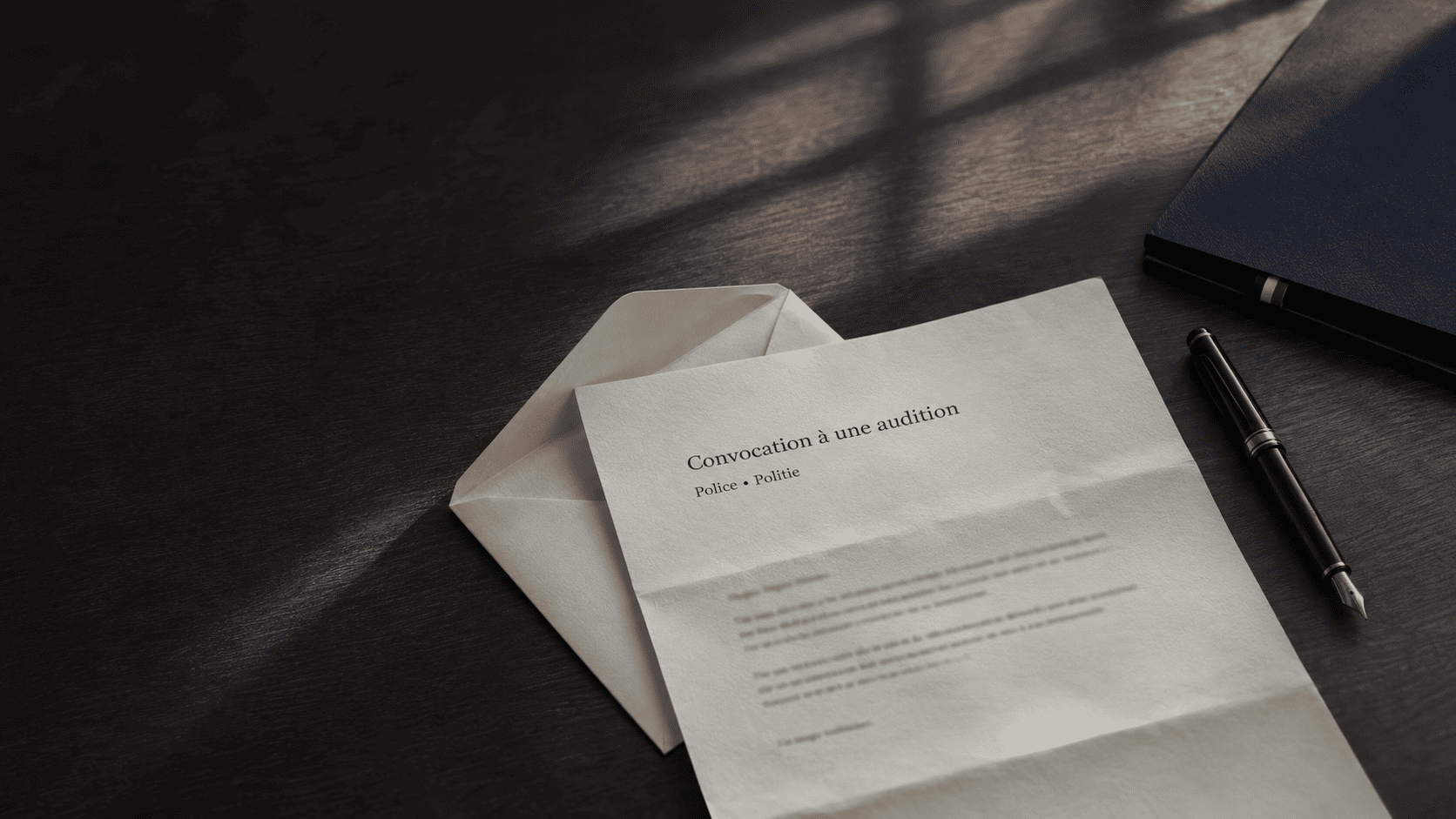
Have you received a police summons in Belgium? It is natural to have questions before attending: why have you been summoned, what should you prepare, and are you entitled to bring a lawyer?
A summons does not mean you are guilty. However, what you say during the interview may be used as evidence in the proceedings. Speaking to a lawyer helps you prepare your statement and exercise your rights. It also allows you to understand your situation, gather the necessary documents and approach the interview with greater peace of mind. At Arthur & Marin, we help you prepare and assist you during the interview. If your interview is already scheduled, let us know the date and time.
What should you do if you receive a police summons?
Read the document in full, including any attachments. First, identify the procedural details: the date, the interview location—which may not be your local police station—the case reference and whether you will be interviewed as a witness, victim or suspect.
Next, check the allegations or events you will be questioned about, along with the information about your rights. You can send us photographs of the document for an initial assessment. Do not wait until the day before to contact us: we need time to examine the documents and arrange to attend your interview.
Why have the police summoned you: as a witness, victim or suspect?
If you are summoned as a witness, investigators want to hear what you personally saw or heard. If you are a victim, the interview gives you an opportunity to describe what happened and explain its consequences. Besides, if you have been the victim of a scam, our guide on what to do after a scam explains the first steps to preserve evidence and try to recover the money paid. Being interviewed as a suspect means that you are suspected of conduct that may constitute a criminal offence. The facts have not yet been established: the investigation is intended to examine them while allowing you to exercise your defence rights.
Being informed of the allegations does not give you immediate access to the complaint or case file. Your interview must therefore be prepared using the information available at that stage. If suspicions arise against you during an interview that began without allegations against you, investigators must provide the safeguards applicable to suspects before continuing.
What happens if you do not attend your police interview?
There is a difference between explaining why you cannot attend and simply failing to respond. If you cannot attend, contact the relevant police department, briefly explain why and ask to reschedule. The consequences of failing to attend depend on the document you received.
⚠️ However, ignoring the letter will not end the investigation. The police or judicial authorities may take other measures permitted by law.
💡 Unable to attend on the scheduled date? Contact our firm so we can assess how best to proceed.
Are you entitled to a lawyer during your interview?
The law guarantees the right to advice and assistance from a lawyer when the police interview you as a suspect. These safeguards are based on Article 47bis of the Belgian Code of Criminal Procedure and the right to a fair trial under Article 6 of the European Convention on Human Rights. In Salduz v. Turkey and Beuze v. Belgium, the European Court of Human Rights emphasised the importance of access to a lawyer from the first police interviews to safeguard defence rights. Legal assistance at this stage can therefore affect the fairness of the proceedings as a whole.
Why consult a lawyer before the interview?
Before answering investigators’ questions, you have the right to speak privately with your lawyer. This allows you to understand the allegations, prepare for possible questions and review your rights. It is also an opportunity to mention any personal difficulties—such as a health condition, language barrier or fatigue—that could affect the interview.
What does a lawyer do at the police station?
Your lawyer does not answer on your behalf but ensures that your rights are respected. Throughout the interview, they check that questioning takes place in appropriate conditions and that your statements are recorded accurately. Within the limits set by law, they may request clarification or ask for relevant observations to be included in the interview record.
💡 At the end of the interview, we review the written record (PV), both orally and in writing. We advise clients on their responses and arrange for an interpreter where necessary.
Can you waive your right to a lawyer?
If you are an adult, you may attend alone and waive legal assistance. However, this decision can directly affect how your case develops.
What documents should you prepare for your police interview?
Start by reviewing the timeline: what happened, on which dates and who was present? This will help you identify documents that can confirm a date, explain an event or support your account. Then gather your summons, identification and any relevant evidence, such as a contract, proof of payment, photographs or a medical certificate. For messages and emails, retain the conversations and original files. Wherever possible, keep dates, contact details and attachments intact.
⚠️ Important: Do not delete or alter any content. To advise you properly, our firm also needs to know about evidence that could be used against you. If you have extensive correspondence, identify the relevant passages. For paper documents, prepare legible copies and keep the originals available.
At Arthur & Marin, we help you organise your documents, identify relevant evidence and review the material. Send us your summons and the information already available.
What happens during an interview at the police station?
Receiving a police summons can be stressful, but understanding the process helps you approach it with greater peace of mind. The interview begins with identity checks and information about the allegations and your rights. The investigator then asks questions and records your answers in a written interview record (PV).
Clarity is essential. If a question is ambiguous, ask for it to be rephrased rather than answering on an assumption. At the end, take time to read the record or ask for it to be read aloud. Pay particular attention to dates, amounts, the people mentioned and nuances in wording: “I assume” does not mean the same as “I confirm”. You may request corrections or additions, and you are not required to sign your statement. Finally, ask for a copy of your interview record, which can be provided free of charge. Remember that it contains your statements, not the entire investigation file.
💡 Practical advice: Try to remain calm and courteous during the interview, even if the questions seem persistent or unsettling, as your conduct also matters.
⚠️ It is recommended that you consult a lawyer before attending the police station to assess your situation and decide whether to answer questions or remain silent.
Do you have to answer every police question?
If you are interviewed as a suspect, you may make a voluntary statement, answer questions or remain silent, as you cannot be compelled to incriminate yourself. How you exercise these rights depends on your circumstances. Sometimes, a voluntary explanation supported by documents can clear up a misunderstanding. Conversely, answering hastily about unclear allegations can create confusion. There is therefore no universal rule that you should explain everything immediately or remain silent. If you choose to answer, be precise: say when you do not know or cannot remember, if that is the case, and distinguish between what you witnessed and what someone else told you.
💡 Important advice: Do not answer based on assumptions or speak simply to fill a silence. If a question is ambiguous, ask for it to be rephrased rather than guessing.
Can you be arrested if you attend the police station voluntarily?
During an interview where you are not detained, you are generally free to leave. However, attending voluntarily does not prevent the authorities from detaining you if the legal conditions are met during the investigation. That decision depends on the evidence in the case, not simply on the reason stated in your summons. If you are detained—meaning the investigator confirms that you are no longer free to leave—additional safeguards apply. The authorities must explain the reasons for your detention and arrange legal assistance. Preparation helps anticipate risks, but cannot guarantee the outcome.
💡 Practical advice: If the situation changes and you are told that you are being detained, remain calm and stop answering questions about the facts of the case. Explicitly ask to speak confidentially with your lawyer before making any further statement.
To understand what may happen after an arrest, our article on pre-trial detention in Belgium explains the conditions for this measure, the investigating judge’s role and the options for challenging detention.
What happens after your police interview?
After you leave the police station, the investigation may continue with further checks, document reviews or interviews with other people. You may also be contacted again to clarify details or answer additional questions. Depending on the findings, the file is sent to the public prosecutor, who decides how to proceed. Several outcomes are possible:
| Possible outcome | What it means |
|---|---|
| No further action | The public prosecutor decides not to pursue the case at this stage. This is not an acquittal, and the decision may be reconsidered, particularly if new evidence emerges. |
| An alternative measure | An alternative to a trial, such as mediation, may be considered if the legal conditions are met. |
| Direct prosecution | The public prosecutor brings the case directly before the competent court for trial. |
| A judicial investigation | An investigating judge takes over the investigation and may order measures within their powers where necessary. |
💡 Remember: not every police interview leads to a trial, and the officer interviewing you does not decide whether you are guilty.
How long does the investigation take?
The duration depends on the enquiries required and the complexity of the case, so timescales vary considerably. Do not expect to receive a letter automatically at every stage. If you want to check progress, access your file or submit new evidence, our lawyers can help.
Will a police interview appear on your criminal record?
A police interview is not a conviction, so it will not appear as such on your criminal record extract. It is important to distinguish between being interviewed, being suspected and being convicted. Understanding this distinction can provide reassurance, particularly if you are dealing with administrative formalities or applying for a job.
⚠️ Important: Although the interview does not appear on your criminal record, the police retain the interview record in their internal databases. Criminal records and police records are separate.
If your concern relates to a previous conviction, read our article on clearing your criminal record and rehabilitation in Belgium, which explains the options for obtaining a clean extract depending on your circumstances.
Examples to help you prepare for your interview
The following cases handled by our firm illustrate the issues that can arise when someone receives a police summons.
A hit-and-run allegation dropped following an alcohol test
A driver was summoned following an alcohol test in a case that also involved a suspected hit-and-run offence. He disputed that allegation and wanted to explain the circumstances of the collision. Our work involved reconstructing the events and gathering evidence supporting his account. We examined photographs and correspondence showing that he had stopped and provided his contact details. We then prepared him for the interview so he could explain what had happened.
💡 This evidence contributed to the decision to take no further action on the hit-and-run allegation. Our involvement helped support his defence against this additional allegation.
Does your summons also concern a traffic offence? Read our article on traffic offences in Belgium to understand the procedure and your defence options.
Evidence supporting the defence that made a difference
A client sought our assistance after being summoned over allegations of violence. The complaint identified our client as the attacker, whereas they explained that they had been struck and had tried to protect themselves. Our work involved documenting circumstances that were missing from the original complaint. We gathered medical certificates, identified witnesses and drew attention to cameras whose footage could clarify the events. We also prepared a timeline with our client to help them explain what happened during the interview.
After further checks, the public prosecutor closed the case because there was insufficient evidence against our client. Our involvement helped ensure that the events were considered as a whole and that our client’s account was supported by evidence.
Alleged threats: putting a conversation back into context
Following a difficult separation, a client was summoned after a complaint based on messages described as threatening. Only selected extracts from the conversation had been given to the police. Our work involved reviewing the full exchange and restoring its context. We arranged the messages chronologically, identified the passages needed to understand the conversation and prepared our client for the interview. The complete exchanges were then submitted for examination.
The public prosecutor ultimately took no further action. Our work helped move beyond a partial reading of the messages and support our client’s explanations with evidence.
A fraud complaint: proving that work had been carried out
A contractor contacted us after receiving a summons concerning a fraud complaint. His customer alleged that he had received an advance payment without completing the agreed work. Our work involved tracing the performance of the contract and documenting how the advance payment had been used. We gathered the quotation, invoices, material orders and correspondence about progress on site. We also prepared a timeline explaining the work completed and the reasons for delays. The documents supported the contractor’s denial of fraudulent intent, and the public prosecutor took no further action on the fraud complaint. The contractual dispute still needed to be resolved, but our involvement helped defend the contractor’s position in the criminal proceedings.
⚠️ Does your summons concern a similar situation? Send it to Arthur & Marin, specifying your interview date. We can discuss what evidence to prepare and how we can assist you.
Is your interview approaching? Send us your summons
To prepare for our first discussion, please send us a legible copy of your summons and any attachments, the interview date, your contact details and a brief account of the facts. We will then tell you which additional documents we need based on your instructions.
If your interview is imminent, mention this when you first contact us. This will allow us to check our availability and whether we can assist you. Contacting us early makes it easier to prepare and arrange legal assistance suited to your situation.
Contact us to prepare for your police interview in Belgium, by telephone on +32 465 345 345 or by email at info@arthurmarin.com.
💡 Disclaimer: This article provides general information about police interviews in Belgium. Its application depends on your status, the allegations and the procedural framework. An individual assessment of your case is needed to determine the most appropriate steps.
By Diego Arturo Espinosa Ibáñez, lawyer at the Brussels Bar — Arthur & Marin
Frequently asked questions about police summonses in Belgium
I have done nothing wrong. Why consult a lawyer?
Speaking to a lawyer beforehand helps clarify your status in the proceedings and identify which facts should be explained or documented to demonstrate your innocence. Preparing for the interview helps protect your position and build your defence.
I do not understand French or Dutch well. Can I request an interpreter?
If you are a suspect and do not understand or speak the language of the proceedings, assistance from a sworn interpreter is provided for. Raise this issue before your appointment so arrangements can be made. Our support can help you prepare, but it does not replace the interpretation required during the proceedings.
My child has been summoned. What should I arrange?
Children interviewed as suspects benefit from additional safeguards, particularly legal assistance, which they cannot waive. A parent’s presence does not replace a lawyer’s assistance. Send us the summons, specifying your child’s age and whether they have been summoned as a suspect, victim or witness, so we can prepare accordingly. Different arrangements apply to children interviewed as victims or witnesses.
I have already been interviewed without a lawyer. Is it still worth consulting one?
Yes. Bring a copy of your interview record if you have one. A lawyer can review your statements, identify procedural issues and assess whether clarification or additional documents would be useful. They can also advise you on the next steps.
Can I change the date or time of my police interview?
Yes, you can request a change. If you have a valid reason, such as illness, previously arranged travel or unavoidable work commitments, contact the investigator using the details on your summons and ask to reschedule. Do this as early as possible, preferably in writing, and provide supporting evidence, such as a medical certificate, to avoid misunderstandings.
Will I know exactly what I am accused of before going to the police station?
By law, the written summons must briefly describe the facts you will be questioned about, such as a traffic offence, theft or assault. It must also state whether you are being summoned as a suspect, witness or victim. However, the police will not disclose the specific details or evidence they hold before the interview begins.
Can my lawyer speak or answer on my behalf during questioning?
Your lawyer’s role is to safeguard your rights, ask for ambiguous questions to be rephrased, check that the interview record accurately reflects your statements and request breaks where necessary. However, they cannot answer questions on your behalf.
How long can a police interview last?
There is no fixed duration. An interview may last from thirty minutes to several hours, depending on the seriousness of the case, the number of questions and whether an interpreter is needed, which often makes the interview longer. It is therefore advisable not to schedule urgent commitments immediately afterwards.