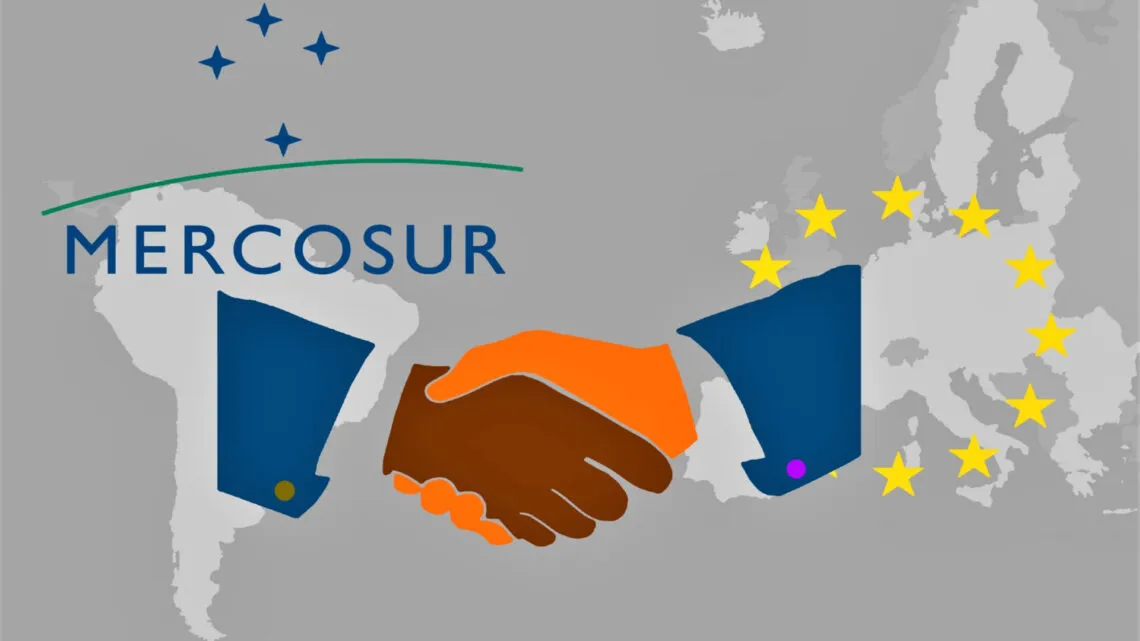
Mercosur (Southern Common Market) is an economic and political bloc that was created in 1991 through the Asunción Treaty. Its official members include Argentina, Brazil, Paraguay, and Uruguay. Additionally, Bolivia, Chile, Colombia, Ecuador, Guyana, Peru, and Suriname participate as associated states. The main objective of the EU – Mercosur trade agreement is to promote integration and economic development.
In a significant milestone, on December 6, 2024, the European Union and Mercosur successfully reached a final partnership agreement. This pact covers cooperation, trade, and investment, aiming to create a common economic space. Through this agreement, both Europe and Latin America will benefit from new economic opportunities, further consolidating a strategic link between the two continents.
What does the agreement consist of?
The EU – Mercosur trade agreement is structured around three main pillars: trade, political dialogue, and cooperation. By eliminating bilateral tariffs, the agreement aims to promote smoother and more competitive trade. Additionally, it facilitates commercial exchange by harmonizing regulations in areas such as technical barriers, sanitary measures, and public procurement.
A notable aspect of the agreement is the protection of over 350 geographical indications from the European Union and more than 220 from Mercosur. This protection ensures the recognition of high-quality products with controlled origins, increasing their value in international markets.
First pillar: International Trade
The agreement between the European Union and Mercosur focuses on:
- Elimination of tariff barriers. The EU will remove over 90% of its tariffs on Mercosur imports. In turn, Mercosur will do the same with approximately 91% of goods from the EU. This agreement covers key sectors such as agricultural products, machinery, chemicals, and vehicles. However, they will require agricultural products to meet strict European food safety standards.
- Non-tariff measures. The agreement also includes non-tariff measures to encourage trade and investment. For example, customs procedures will be simplified, technical trade barriers will be reduced, and sanitary measures will be harmonized.
- Market access and SME support. The agreement will improve access for businesses to both regions’ service markets, including telecommunications, transport, and financial services. Currently, more than 30.000 European SMEs export to Mercosur. The agreement could increase this number by simplifying market access, and vice versa.
- Improvement of access to essential raw materials. The agreement will reduce or eliminate export taxes and restrictions, dismantling existing export monopolies to ensure wider access to essential raw materials.
- Sustainability, labor rights, and the environment. The agreement includes commitments to comply with the Paris Agreement on climate change and ensure high standards in labor rights, environmental protection, and consumer protection.
- Intellectual property and public procurement. The agreement will enhance intellectual property protections and open access to public procurement in both blocs.
Second and third pillars: Political dialogue and cooperation
In the migration sector, the agreement proposes joint management of flows, prioritizing effectiveness and full respect for human rights. Additionally, in the digital economy, it will promote both technological innovation and digitalization.
At the same time, the pact prioritizes collaboration in research and education, encouraging projects that enhance knowledge exchange. On the other hand, it promotes responsible business practices and commits both parties to joint actions to combat climate change and preserve ecosystems.
Benefits of the agreement for both parties
The EU – Mercosur trade agreement promises significant benefits for both the European Union and Mercosur. These are outlined below:
European Union
On one hand, the European Union will experience a major market expansion, gaining preferential access to a market of over 260 million consumers. This will open new opportunities for European companies, especially in industrial and technological sectors. Additionally, the agreement will significantly contribute to the EU’s trade diversification while reducing its dependency on traditional markets.
Southern common market (Mercosur)
Unprecedented access to the European market will present an opportunity to increase exports, particularly agricultural products and raw materials. Moreover, the agreement will encourage economic modernization, promoting structural reforms that will boost the competitiveness of its economies.
Greater legal certainty, alongside the standards set by the agreement, will attract foreign direct investment. In the long run, flows between Mercosur and the EU are expected to increase by 37%, with minimal negative effects or impact on trade with other geographical regions.
Next steps in the EU – Mercosur trade agreement
For the EU – Mercosur trade agreement to come into effect, it must go through a formal ratification process in both regions. The agreement presents this process in two separate treaties to simplify it. This is because the trade provisions only require ratification by EU institutions (Council and European Parliament). However, the political dialogue and cooperation areas require approval from the national parliaments of all EU member states.
On Mercosur’s side, each country will ratify the agreement according to its legislative procedures. Unanimity is not required; it will come into force bilaterally after parliamentary approval.
In summary, if ratified, the EU will have free trade agreements with 94% of Latin America’s GDP, surpassing the U.S. (44%) and China (14%). This would make it the primary strategic partner for Latin America.
Contact Arthur & Marin for specialized advice on International Trade. Based in the European capital, Brussels, with a multilingual team, we offer personalized legal solutions in International Commercial Law.
Reach us at info@arthurmarin.com or call us at +32 465 345 345.